


A Modern Groom’s Sherwani Story: Between Roots and Runways
The Sherwani Story Begins
The house had been awake since dawn.
Footsteps moved constantly across marble floors. Suitcases lay half-zipped. Phone calls overlapped with instructions about flowers, photographers, and arrival timings. Somewhere downstairs, someone was testing the speakers for the sangeet playlist. The wedding had not begun yet, but it had already taken over the house.
Inside his room, however, the noise felt distant.
Aarav stood in front of his open wardrobe, arms folded loosely, staring at two distinct sections that seemed to represent two different worlds. The wooden hanger on the left carried sherwanis that felt rooted, textured silks, deeper tones, and traditional embroidery that held quiet authority. On the right hung sharper silhouettes, lighter ivories, muted pastels, structured tailoring that felt almost architectural.

He hadn’t planned for this split.
Yet here it was.
This was the moment where his Sherwani Story truly began.
For most of his life, the idea of a groom had been simple in his mind. A sherwani meant tradition. It meant dignity. It meant stepping into a role that men before him had stepped into, calmly and confidently, without questioning the uniform of the occasion. As a child attending weddings, he never analysed the cut or colour. He only noticed how the groom looked different from everyone else.
Now that he was the groom, the steadiness felt less automatic.
Over the past few weeks, Aarav had saved images obsessively. Runway features. Destination wedding editorials. Celebrity grooms redefining the silhouette with experimental shades and contemporary tailoring. At the same time, he had revisited old family albums. His father in a richly embroidered sherwani, standing tall under a sehra, eyes serious yet proud.
Somewhere between those two references, he began to pause.
He didn’t want to look like a relic of the past.
But he didn’t want to look like a costume curated for social media either.
This Groom Sherwani Story was not about fabric alone; it was about alignment. It was about standing at the intersection of heritage and personal expression without feeling pulled apart by either. Aarav wasn’t rejecting tradition; he respected it deeply. Nor was he blindly chasing modern fashion.
But standing between the two wardrobes, he realised something unsettling, he didn’t fully belong to either extreme.
What does it mean to honour where you come from?
What does it mean to represent who you are today?
And can both exist in the same silhouette?
Outside his door, someone called his name.
“Aarav! The tailor’s coming in an hour!”
He responded automatically, but his eyes remained fixed on the wardrobe. Because before fittings, before photographs, before rituals, there was this pause. A moment of reflection.
Aarav understood that his Sherwani Story was not about choosing sides. It was about adjusting it with balance.
And balance, he realised, would not be found in trends or tradition alone, but in the space where both collided.
Growing Up With Traditions
Long before Aarav knew what tailoring meant, before he understood embroidery techniques or silhouette structures, he knew what a groom looked like.
He had seen him.
In courtyards lit with flowers and under mandaps fragrant with incense.
The groom always wore a traditional sherwani.
As a child, Aarav never called it that. To him, it was simply “the groom’s outfit.” It was the attire that signalled importance. The moment a man stepped into a traditional sherwani, the room shifted around him.
He remembers sitting cross-legged beside his cousins during long wedding rituals, his attention wandering between sacred chants and the intricate patterns on the groom’s sleeves. The sherwani seemed heavier than the rest of the clothing in the room, not physically intimidating, but symbolically grounded.
Every wedding he attended followed the same visual rhythm. Creams and golds. Deep maroons. Embroidery that was detailed but dignified. Structured collars, buttons fastened with quiet precision. The traditional sherwani was never loud, yet it commanded attention.
And no one questioned it.
It was like a rite of passage stitched into fabric.
At home, there was a photograph of his father on his wedding day. The frame had slightly faded over the years, but the sherwani remained striking, rich, structured, regal, without extravagance. Whenever guests visited, that photograph was shown with pride.
“That’s how a groom should look,” someone would inevitably say.
But what stayed with Aarav wasn’t the comment. It was the expression on his father’s face, calm, steady, almost reflective. The traditional sherwani didn’t make him look ornamental.
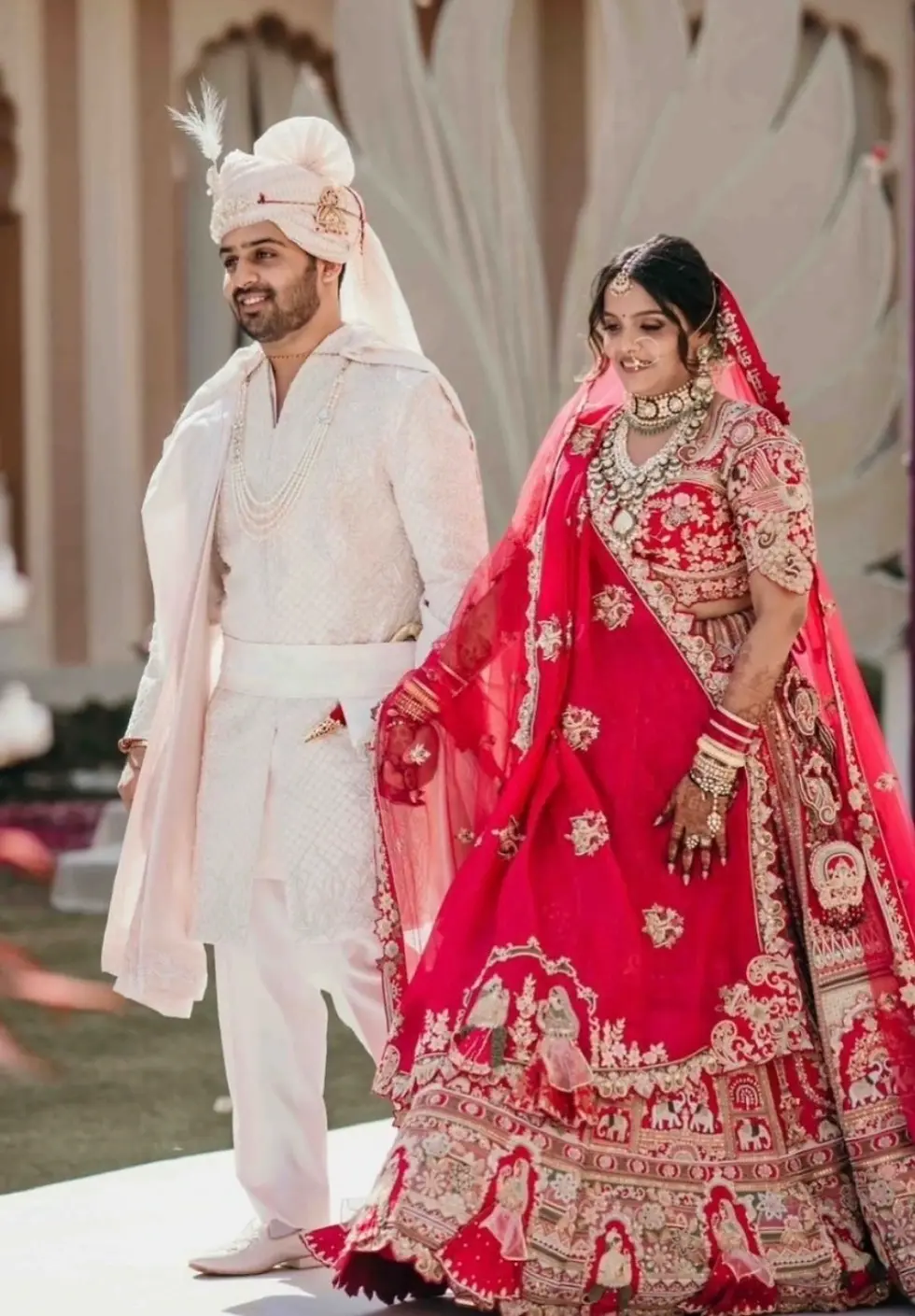
As he grew older, Aarav began to understand that tradition wasn’t about rigidity. It was about continuity. The traditional sherwani represented more than embroidery patterns or familiar colour palettes. It represented participation in something older than himself, a lineage of ceremonies, blessings, expectations, and joy.
And yet, what he felt toward it was not pressure.
Because in those memories, the sherwani wasn’t worn for photographs or approval. It was worn for meaning.
Standing in front of his wardrobe now, those images returned to him quietly. The left side, the richer fabrics, the intricate detailing, it felt like an echo of every wedding he had witnessed growing up.
And Aarav knew that whatever choice he made for his wedding day, he could not ignore the foundation that shaped him. Tradition was not something he was trying to escape.
It was something he was trying to understand in his own way.
When Modern Style Entered The Conversation
Tradition had shaped Aarav’s earliest understanding of what a groom should look like. But somewhere between college years and career milestones, another influence quietly entered the picture. But it did arrive in fragments.
A destination wedding video was forwarded to a family group.
A fashion week clip shared by a friend.
A celebrity wedding that seemed to flood every screen at once.
And for the first time, Aarav noticed something different.
The grooms didn’t all look the same anymore.
Some wore sharply tailored silhouettes in muted ivories. Others experimented with pastel tones and minimal embroidery. There were layered drapes, asymmetric cuts, structured shoulders that felt architectural rather than ornamental. The sherwani was still there, but it had evolved.
He found himself pausing longer than usual while scrolling.
A celebrity-inspired sherwani carried a different kind of confidence. It wasn’t rooted only in heritage but also in personal branding. The groom looked comfortable in front of the cameras, almost editorial. The tailoring hugged the body more precisely. The styling felt intentional, curated.
For years, he had associated the sherwani with ceremonial gravity. But here was a modern Sherwani style that felt breathable, adaptable, and expressive. It did not abandon structure, yet it seemed to remove unnecessary heaviness. The colours were softer, dusty rose, sage green, champagne beige. The embroidery, when present, was deliberate rather than dense.
It felt less like an obligation and more like a design.
Aarav wasn’t rejecting the traditional sherwani he grew up seeing. Instead, he was discovering that the garment had expanded beyond his childhood definition. The sherwani had stepped onto runways. It had been reinterpreted by designers. It had been reshaped to fit contemporary sensibilities.

And as he studied these newer silhouettes, he felt something shift within himself.
He no longer saw two opposing worlds.
He saw possibilities.
A celebrity-inspired sherwani did not necessarily indicate flashy excess.
Still, curiosity brought its own questions.
If tradition felt like belonging, and modern style felt like expression, where did he stand?
Was the updated silhouette a reflection of who he had become? A professional navigating urban spaces, comfortable in structured suits and minimal palettes? Or was he trying to adopt an aesthetic shaped by curated feeds and spotlighted weddings?
As these thoughts layered over one another, Aarav realised something subtle.
He was no longer choosing between old and new.
He was negotiating identity.
The sherwani was no longer a fixed image from childhood. It had become fluid.
And somewhere between the richness of memory and the precision of modern tailoring, a quiet tension began to form.
It was a pause that would lead him to the real question at the heart of his Groom Sherwani Story: was he meant to stand entirely in one wardrobe or could he build something in between?
Caught Between Roots and Runways
The wardrobe had never felt this symbolic before.
On the left hung familiarity, fabrics that echoed childhood weddings, embroidery that felt ceremonial, silhouettes that carried generational memory. On the right stood precision, cleaner lines, lighter palettes, and a confidence shaped by contemporary design.
Aarav stood between them, not confused, but unsettled.
He realised something quietly uncomfortable; he did not fully belong to either extreme.
If he chose something deeply traditional, would he feel himself entirely, or would he feel like he was stepping into a version of masculinity defined decades before him? A dignified, composed groom who stood still while rituals unfolded around him.
And if he chose something entirely fashion-forward, something sharply tailored and minimal, would it truly reflect him, or would it feel like he was borrowing confidence from curated imagery?
He thought about the kind of man he had become. He was rooted, yes, he valued rituals, respected elders, and found comfort in familiarity. But he was also modern in his worldview. He questioned things. He adapted. He moved through urban spaces where personal style was an extension of identity.
So why did it feel as if the sherwani required a binary decision?
Perhaps because weddings amplify everything.
They magnify expectation, they frame identity, and they freeze moments into photographs that will outlive trends.
A sherwani worn casually at a celebration is just attire. But a sherwani worn as a groom becomes documentation. It becomes part of family history.
That thought lingered.
He imagined future years, someone flipping through an album, pausing at his photograph. What would they see? A man holding onto the past? Or a man trying too hard to redefine it?
Neither felt accurate.

Aarav did not want to reject his roots. But he did not want to perform the tradition either. He did not want to chase runway aesthetics. But he did not want to ignore evolution.
Standing there, he understood something deeper about his Sherwani Story.
Roots and runways were not enemies. They were chapters. And perhaps the discomfort he felt was not a sign of indecision, but a sign that he was thinking carefully.
That pause, that internal negotiation, was part of the journey.
Because balance is rarely loud.
It is discovered in silence.
And in that silence, Aarav began to consider a possibility he hadn’t allowed himself before:
What if the sherwani didn’t have to represent one world completely?
What if it could represent him?
Redefining What A Sherwani Means Today
The realisation did not arrive dramatically.
Aarav stopped looking at the wardrobe as two opposing sides. Instead, he began looking at it as one continuum. Tradition had not frozen in time. Fashion had not appeared out of nowhere. Both had evolved, and perhaps the sherwani had evolved with them.
For years, he had seen the sherwani as a fixed symbol. It represented dignity, lineage, and continuity.
But wasn’t continuity itself a form of evolution?
He began to notice something subtle in the modern interpretations he had admired. The modern Sherwani style did not erase heritage. It reduced excess without removing meaning.
That thought stayed with him.
Maybe tradition was never meant to feel heavy. Maybe it only felt heavy when it wasn’t adapted.
A sherwani, at its core, was not about the density of embroidery or the boldness of colour. It was about a marking transition. It was about presence at a sacred threshold. Whether richly adorned or minimally tailored, its purpose remained the same.
The difference lay in interpretation.
He thought about his father’s photograph again. The traditional sherwani his father wore had felt contemporary in its time. It had been chosen carefully, likely reflecting what felt modern then. What Aarav had grown up calling “classic” had once been someone else’s innovation.
That perspective shifted everything.
Designers were not rewriting culture; they were translating it for the present. They acknowledged that grooms today live in different worlds from those of grooms decades ago.
And Aarav moved through those worlds, too.
He wore structured blazers to work. Preferred muted tones. Valued simplicity in everyday life. Why, then, should his wedding attire feel disconnected from his lived identity?
Redefining what a sherwani meant today did not require abandoning the past. It required understanding its essence.
Once he saw it that way, the tension softened.
He no longer felt caught between roots and runways. He felt positioned at their intersection, where thoughtful design could honour ritual without overwhelming it. Where tailoring could feel contemporary without becoming costume.
A Look That Felt Familiar, Yet New
Aarav stood once more before the wardrobe, but this time, he wasn’t analysing categories. He wasn’t measuring embroidery density against tailoring precision. He wasn’t weighing memory against modernity.
He was asking one question:
Does this feel like me?
The sherwani he finally chose did not sit entirely on the left or the right. It held the structure of tradition, a silhouette that carried ceremony with quiet authority. But its tailoring was cleaner, its embroidery was more restrained. The colour was soft enough to feel contemporary, yet rich enough to feel rooted.
When he tried it on, it felt uniquely comfortable. His shoulders settled. His breathing felt steady. He didn’t feel like he was stepping into someone else’s expectations. He didn’t feel like he was performing modernity either.
The fabric moved with him rather than against him. The detailing caught light without demanding it.
For the first time in weeks, he stopped imagining how others would perceive it.
He focused on how it felt to stand in it.
The sherwani no longer represented a debate between roots and runways. It represented integration. It allowed him to carry forward what mattered without feeling weighed down by what no longer reflected him.
It felt familiar because it honoured where he came from.
It felt new because it reflected who he had become.
Walking Into The Wedding as Himself
The wedding morning arrived faster than expected.
Voices echoed through the house. The scent of incense drifted in from the courtyard. Someone knocked twice on his door before opening it halfway to remind him that the baraat would begin soon.
Aarav stood before the mirror once more, but this time, he was dressed.

There was no second-guessing. No internal comparison to runway images. No lingering thoughts about whether he had honoured tradition enough or embraced modern style sufficiently.
The sherwani sat on him as if it had always belonged there.
When his mother entered the room, her expression softened. She adjusted his collar gently, a gesture he had watched her perform at countless weddings before. His father stood quietly near the doorway, pride evident in his stillness.
In that moment, Aarav understood something deeper about his Sherwani story.
It had never truly been about choosing between tradition and trend.
It had been about choosing alignment.
As he stepped out toward the waiting baraat, he did not feel like a symbol of the past or a product of the runway. He felt present.
The music grew louder. Friends gathered around him. The celebration expanded outward.
But inside, he felt steady.
This Groom Sherwani Story did not end with applause or admiration. It culminated in presence, in walking toward the mandap without discomfort, without performance, without doubt.
And perhaps that is where most modern grooms eventually arrive.
Between roots and runways, Aarav did not lose himself.
Where Modern Grooms Often Arrive
Aarav’s journey is not unique, and that is precisely what makes it meaningful. Many modern grooms find themselves standing between memory and modernity, between a traditional vision and a contemporary expression of self. The Sherwani Story today is rarely about choosing one over the other. It is about understanding both.

A traditional sherwani carries heritage. A modern Sherwani style reflects the present. But the most powerful Groom Sherwani Story unfolds when the two coexist naturally, when a groom chooses not from pressure or trend, but from alignment.
Because in the end, the sherwani that matters most is the one that feels like home, even on a new beginning.

Comments